| [ Team LiB ] |


|
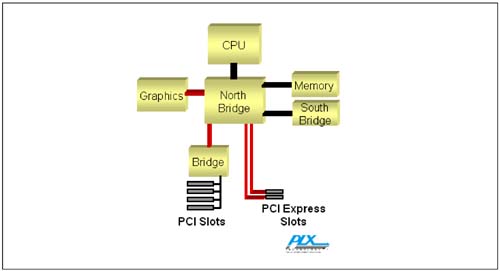
Enterprise Computing SystemsPCI Express is expected to be deployed initially in desktop and server systems. These computers typically utilize a chipset solution that includes one or more microprocessors and two types of special interconnect devices, called northbridges and southbridges. Northbridges connect the CPU with memory, graphics and I/O. Southbridges connect to standardized I/O devices such as hard disk drives, networking modules or devices, and often PCI expansion slots. Desktop SystemsTypical use of PCI Express in a desktop application is shown in Figure B-2 on page 992. The PCI Express ports come directly out of the northbridge, and are bridged to PCI slots that are used for legacy plug-in cards. In some implementations the PCI Express interconnections will be completely hidden from the user behind PCI bridges, and in other implementations there will be PCI Express slots in a new PCI Express connector form factor. Figure B-2. PCI Express in a Desktop System
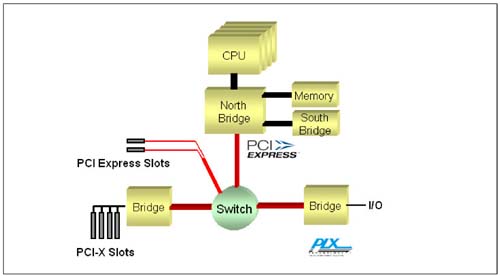
The major benefit for using PCI Express in this application is the low pin count associated with serial interface technology, which will translate into lower cost. This low pin count provides the ability to create northbridges and I/O bridges with smaller footprints, and a significantly fewer number of board traces between the components. This provides a major reduction in the area and complexity of the signal/trace routing in PCBs. Server SystemsFigure B-3 on page 993 shows PCI Express used in an enterprise server system. This system has similarities to the desktop system, since there is a northbridge and southbridge providing functions that parallel their roles in the desktop system, and the form factor of the system is often similar. Servers, however, place a greater emphasis on performance than desktop systems do. Figure B-3. PCI Express in a Server System
To achieve their performance and time to market objectives, server designers have adopted PCI-X. The primary attraction to PCI-X has been increased throughput, but with PCI code compatibility. PCI-X offers clear benefits compared to PCI, and will remain in server systems for a long while, but it suffers from the same shared bus limitations that have already been discussed. The high throughput of PCI Express serial interconnection provides a measurable benefit versus legacy interconnect technologies, especially as the speed of the I/O interconnect and the number of high speed I/O ports on each card increases. Some systems will only provide PCI-X slots, but many newer systems will also offer several PCI Express slots. The number of PCI Express slots will grow over time compared to the PCI-X slots, and eventually will become dominant in the same way that PCI did with previous interconnect technologies. Since bandwidth is a primary motivator for a server, typical PCI Express slots will be either x4 or x8 lanes. In most low to midrange server systems, the PCI-X bridging and PCI Express slots will be provided by using the ports right off of the northbridge. However, high-end systems will require more I/O slots of both kinds. Since PCI Express is a point-to-point technology, the only way to provide additional connection links is through a device called a fan out switch. Specifically, the purpose of a fan out switch is to multiply the number of PCI Express lanes from an upstream host port to a higher number of downstream PCI Express devices. Figure 3 below, shows a PCI Express switch used in the system for this purpose. |
| [ Team LiB ] |
|