| [ Team LiB ] |


|
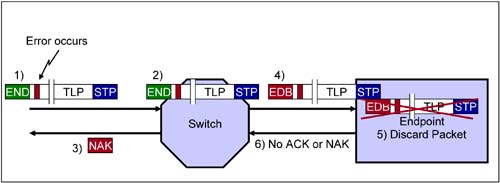
Switch Cut-Through ModePCI Express supports a switch-related feature that allows TLP transfer latency through a switch to be significantly reduced. This feature is referred to as the 'cut-through' mode. Without this feature, the propagation time through a switch could be significant. Without Cut-Through ModeBackgroundConsider an example where a large TLP needs to pass through a switch from one port to another. Until the tail end of the TLP is received by the switch's ingress port, the switch is unable to determine if there is a CRC error. Typically, the switch will not forward the packet through the egress port until it determines that there is no CRC error. This implies that the latency through the switch is at least the time to clock the packet into the switch. If the packet needs to pass through many switches to get to the final destination, the latencies would add up, increasing the time to get from source to destination. Possible SolutionOne option to reduce latency would be to start forwarding the TLP through the switch's egress port before the tail end of the TLP has been received by the switch ingress port. This is fine as long as the packet is not corrupted. Consider what would happen if the TLP were corrupt. The packet would begin transmitting through the egress port before the switch realized that there is an error. After the switch detects the CRC error, it would return a NAK to the TLP source and discard the packet, but part of the packet has already been transmitted and its transmission cannot be cleanly aborted in mid-transmit. There is no point keeping a copy of the bad TLP in the egress port Replay Buffer because it is bad. The TLP source port would at a later time replay after receiving the NAK DLLP. The TLP is already outbound and en route to the Endpoint destination. The Endpoint receives the packet, detects a CRC error, and returns a NAK to the switch. The switch is expected to replay the TLP, but the switch has already discarded the TLP due to the detected error on the inbound TLP. The switch is stuck between a rock and a hard place! Switch Cut-Through ModeBackgroundThe PCI Express protocol permits the implementation of an optional feature referred to as cut-through mode. Cut-though is the ability to start streaming a packet through a switch without waiting for the receipt of the tail end of the packet. If, ultimately, a CRC error is detected when the CRC is received at the tail end of the packet, the packet that has already begun transmission from the switch egress port can be 'nullified'. A nullified packet is a packet that terminates with an EDB symbol as opposed to an END. It also has an inverted 32-bit LCRC. Example That Demonstrates Switch Cut-Through FeatureConsider the example in Figure 5-17 that illustrates the cut-though mode of a switch. Figure 5-17. Switch Cut-Through Mode Showing Error Handling
A TLP with large data payload passes from the left, through the switch, to the Endpoint on the right. The steps as the packet is routed through the switch are as follows:
When the TLP source device receives the NAK DLLP, it replays the packet. This time no error occurs on the switch's ingress port. As the packet arrives in the switch, the header is decoded and the TLP is forwarded to the egress port with very short latency. When the tail end of the TLP arrives at the switch, a CRC check is performed. There is no error, so an ACK is returned to the TLP source which then purges its replay buffer. The switch stores a copy of the TLP in its egress port Replay Buffer. When the TLP reaches the destination Endpoint, the Endpoint device performs a CRC check. The packet is a good packet terminated with the END framing symbol. There are no CRC errors and so the Endpoint returns an ACK DLLP to the switch. The switch purges the copy of the TLP from its Replay Buffer. The packet has been routed from source to destination with minimal latency. |
| [ Team LiB ] |
|