| [ Team LiB ] |


|
Quality of ServiceQuality of Service (QoS) is a generic term that normally refers to the ability of a network or other entity (in our case, PCI Express) to provide predictable latency and bandwidth. QoS is of particular interest when applications require guaranteed bus bandwidth at regular intervals, such as audio data. To help deal with this type of requirement PCI Express defines isochronous transactions that require a high degree of QoS. However, QoS can apply to any transaction or series of transactions that must traverse the PCI Express fabric. Note that QoS can only be supported when the system and device-specific software is PCI Express aware. QoS can involve many elements of performance including:
Several features of PCI Express architecture provide the mechanisms that make QoS achievable. The PCI Express features that support QoS include:
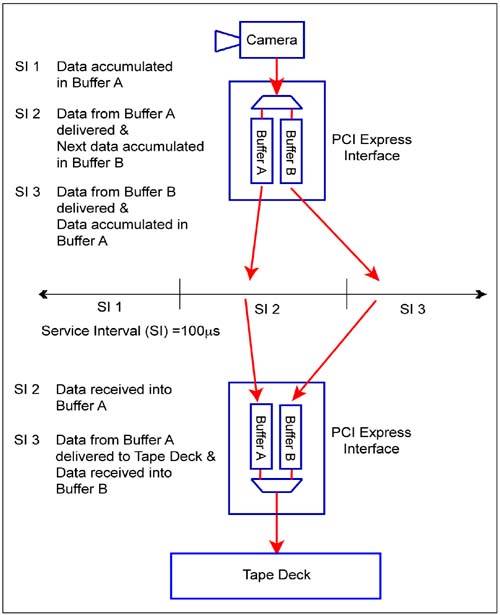
PCI Express uses these features to support two general classes of transactions that can benefit from the PCI Express implementation of QoS. Isochronous Transactions — from Iso (same) + chronous (time), these transactions require a constant bus bandwidth at regular intervals along with guaranteed latency. Isochronous transactions are most often used when a synchronous connection is required between two devices. For example, a CD-ROM drive containing a music CD may be sourcing data to speakers. A synchronous connection exists when a headset is plugged directly into the drive. However, when the audio card is used to deliver the audio information to a set of external speakers, isochronous transactions may be used to simplify the delivery of the data. Asynchronous Transactions — This class of transactions involves a wide variety of applications that have widely varying requirements for bandwidth and latency. QoS can provide the more demanding applications (those requiring higher bandwidth and shorter latencies) with higher priority than the less demanding applications. In this way, software can establish a hierarchy of traffic classes for transactions that permits differentiation of transaction priority based on their requirements. The specification refers to this capability as differentiated services. Isochronous Transaction SupportPCI Express supports QoS and the associated TC, VC, and arbitration mechanisms so that isochronous transactions can be performed. A classic example of a device that benefits from isochronous transaction support is a video camera attached to a tape deck. This real-time application requires that image and audio data be transferred at a constant rate (e.g., 64 frames/second). This type of application is typically supported via a direct synchronous attachment between the two devices. Synchronous Versus Isochronous TransactionsTwo devices connected directly perform synchronous transfers. A synchronous source delivers data directly to the synchronous sink through use of a common reference clock. In our example, the video camera (synchronous source) sends audio and video data to the tape deck (synchronous sink), which immediately stores the data in real time with little or no data buffering, and with only a slight delay due to signal propagation. When these devices are connected via PCI Express a synchronous connection is not possible. Instead, PCI Express emulates synchronous connections through the use of isochronous transactions and data buffering. In this scenario, isochronous transactions can be used to ensure that a constant amount of data is delivered at specified intervals (100µs in this example), thus achieving the required transmission characteristics. Consider the following sequence (Refer to Figure 6-1 on page 254):
Figure 6-1. Example Application of Isochronous Transaction
Isochronous Transaction ManagementManagement of an isochronous communications channel is based on a Traffic Class (TC) value and an associated Virtual Channel (VC) number that software assigns during initialization. Hardware components including the Requester of a transaction and all devices in the path between the requester and completer are configured to transport the isochronous transactions from link to link via a hi-priority virtual channel. The requester initiates isochronous transactions that include a TC value representing the desired QoS. The Requester injects isochronous packets into the fabric at the required rate (service interval), and all devices in the path between the Requester and Completer must be configured to support the transport of the isochronous transactions at the specified interval. Any intermediate device along the path must convert the TC to the associated VC used to control transaction arbitration. This arbitration results in the desired bandwidth and latency for transactions with the assigned TC. Note that the TC value remains constant for a given transaction while the VC number may change from link to link. Differentiated ServicesVarious types of asynchronous traffic (all traffic other than isochronous) have different priority from the system perspective. For example, ethernet traffic requires higher priority (smaller latencies) than mass storage transactions. PCI Express software can establish different TC values and associated virtual channels and can set up the communications paths to ensure different delivery policies are established as required. Note that the specification does not define specific methods for identifying delivery requirements or the policies to be used when setting up differentiated services. |
| [ Team LiB ] |
|