Support for PCI Buses and Deadlock Avoidance
Because the PCI bus employs delayed transactions, several deadlock scenarios can develop. These deadlock avoidance rules are included in PCI Express ordering to ensure that no deadlocks occur regardless of topology. Adhering to the ordering rules prevent problems when boundary conditions develop due to unanticipated topologies (e.g., two PCI Express to PCI bridges connected across the PCI Express fabric). Refer to the MindShare book entitled PCI System Architecture, Fourth Edition (published by Addison-Wesley) for a detailed explanation of the scenarios that are the basis for the PCI ordering rules related to deadlock avoidance. Table 8-4 on page 327 lists and highlights the deadlock avoidance ordering rules. Note that avoiding the deadlocks involves "Yes" entries in each case. If blocking occurs, the transaction in column 1 must be moved ahead of the transaction specified in the column where the "Yes" entry exists. Note also that the "Yes" entries in A5b and A6b apply only to PCI Express to PCI Bridges and PCI Express to PCI-X Bridges.
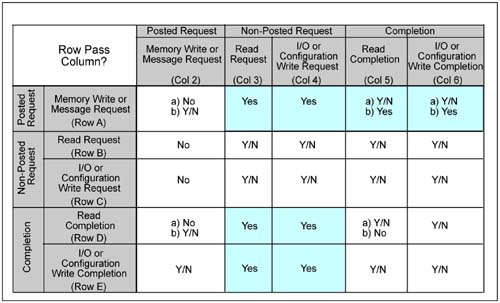
The specification provides the following explanation of the table entries:
A2a —
A Memory Write or Message Request with the Relaxed Ordering Attribute bit clear (0b) must not pass any other Memory Write or Message Request.
A2b —
A Memory Write or Message Request with the Relaxed Ordering Attribute bit set (1b) is permitted to pass any other Memory Write or Message Request.
A3, A4 —
A Memory Write or Message Request must be allowed to pass Read Requests and I/O or Configuration Write Requests to avoid deadlocks.
A5a, A6a —
Endpoints, Switches, and Root Complexes may either allow Memory Write and Message Requests to pass Completions or to be blocked by Completions.
A5b, A6b —
PCI Express to PCI Bridges and PCI Express to PCI-X Bridges (when operating in PCI mode), must allow Memory Write and Message Requests to pass Completions traveling in the PCI Express to PCI direction (Primary side of Bridge to Secondary side of Bridge) to avoid deadlock.
B2, C2 —
These Requests cannot pass a Memory Write or Message Request. This preserves strong write ordering required to support the Producer/Consumer model.
B3, B4, C3, C4 —
Read Requests and I/O or Configuration Write Requests are permitted to be blocked by or to pass other Read Requests and I/O or Configuration Write Requests.
B5, B6, C5, C6 —
The Requests specified are permitted to be blocked by or to pass Completions.
D2a —
If the Relaxed Ordering attribute bit is not set, then a Read Completion cannot pass a previously enqueued Memory Write or Message Request.
D2b —
If the Relaxed Ordering attribute bit is set, then a Read Completion is permitted to pass a previously enqueued Memory Write or Message Request.
D3, D4, E3, E4 —
Completions must be allowed to pass Read and I/O or Configuration Write Requests to avoid deadlocks.
D5a —
Read Completions associated with different Read Requests are allowed to be blocked by or to pass each other.
D5b —
When multiple completions are returned in response to a single Read Request, the completions must return the requested read data in the proper address order. Note that the data returned in each completion is delivered in ascending address order. Switches can recognize this condition because each completion will have the same Transaction ID. Completions with different transaction IDs can be reordered without concern.
D6 Read —
Completions are permitted to be blocked by or to pass I/O or Configuration Write Completions.
E2 —
I/O or Configuration Write Completions are permitted to be blocked by or to pass Memory Write and Message Requests. Such transactions are actually moving in the opposite direction, and have no ordering relationship.
E5, E6 —
I/O or Configuration Write Completions are permitted to be blocked by or to pass Read Completions and other I/O or Configuration Write Completions.
The specification also states the following additional rules:
For Root Complex and Switch, Memory Write combining (as defined in the PCI Specification) is prohibited. Note: This is required so that devices can be permitted to optimize their receive buffer and control logic for Memory Write sizes matching their natural expected sizes, rather than being required to support the maximum possible Memory Write payload size. Combining of Memory Read Requests, and/or Completions for different Requests is prohibited. The No Snoop bit does not affect the required ordering behavior.
|

