| [ Team LiB ] |


|
Special Consideration for Base System PeripheralsInterrupts may also originate in embedded legacy hardware, such as an I/O Controller Hub or Super I/O device. Some of the typical legacy devices required in such systems include:
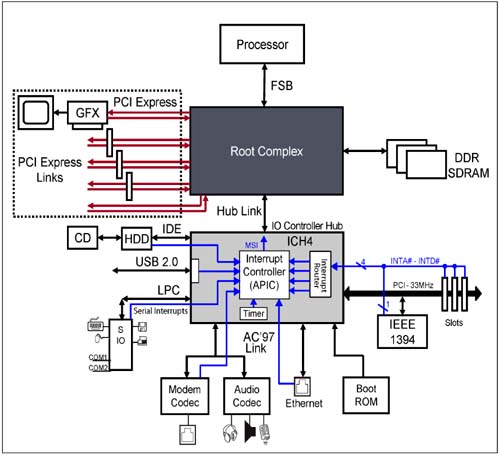
These devices typically require a very specific IRQ line, which allows legacy software to interact with them correctly. Using the INTx messages does not guarantee that the devices will receive the IRQ assignment that they require. Many different approaches and strategies may be employed to ensure they get the IRQs required. Following is an example system that supports legacy interrupt assignment. Example SystemFigure 9-14 on page 354 illustrates a PCI Express system that includes an existing I/O Controller Hub (ICH) that attaches to the Root Complex via a proprietary link. The interrupt controller that is embedded within the ICH is an IOAPIC that can generate an MSI when it receives an interrupt request at its inputs. In such an implementation, software can assign the legacy vector number to each input, to ensure the correct legacy software is called. Figure 9-14. PCI Express System with PCI-Based IO Controller Hub
The advantage to this approach is that existing hardware can be used to support the legacy requirements within a PCI Express platform. This system also requires that the MSI subsystem be configured for use during the boot sequence. The example illustrated eliminates the need for INTx messages, unless a PCI Express expansion device incorporates a PCI Express-to-PCI Bridge. |
| [ Team LiB ] |
|