| [ Team LiB ] |


|
Hot Plug in the PCI Express EnvironmentPCI Express Hot Plug is derived from the 1.0 revision of the Standard Hot Plug Controller specification (SHPC 1.0) for PCI. The goals of PCI Express Hot Plug are to:
PCI Express defines the registers necessary to support the integration of a Hot Plug Controller within individual root and switch ports. Under Hot Plug software control, these Hot Plug controllers and the associated port interface within the root or switch port must control the card interface signals to ensure orderly power down and power up as cards are removed and replaced. Hot Plug controllers must:
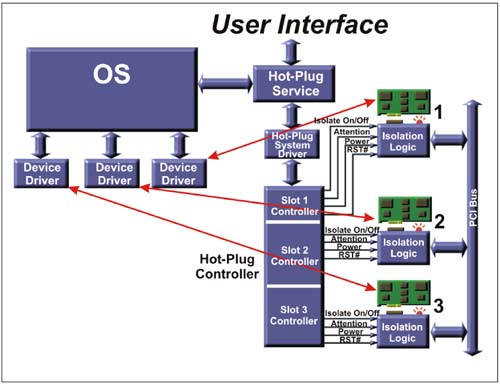
PCI Express Hot-Plug (like PCI) is designed as a "no surprises" Hot-Plug methodology. In other words, the user is not permitted to install or remove a PCI Express card without first notifying software. System software then prepares both the card and slot for the card's removal and replacement, and finally indicates to the end user (via visual indicators) status of the hot plug process and notification that installation or removal may be performed. Surprise Removal NotificationPCI Express cards (unlike PCI) must implement the edge contacts with card presence detect pins (PRSNT1# and PRSNT2#) that break contact first (when the card is removed from the slot). This gives advanced notice to software of a "surprise" removal and enough time to remove power prior to the signals breaking contact. Differences between PCI and PCI Express Hot PlugThe elements needed to support hot plug are essentially the same between PCI and PCI Express hot plug solutions. Figure 17-1 on page 653 depicts the PCI hardware and software elements required to support hot plug. PCI solutions implement a single standardized hot plug controller on the system board that permits all hot plug slots on the bus to be controlled by a single controller. Also, isolation logic is needed in the PCI environment to electrically disconnect a single card slot from the bus prior to card removal. Figure 17-1. PCI Hot Plug Elements
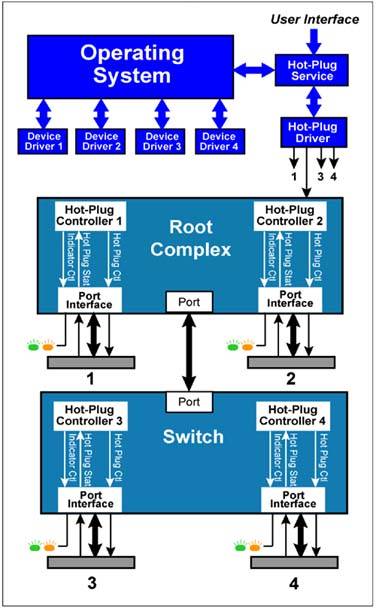
PCI Express Hot Plug differs from the PCI implementation due to point-to-point connections. (See Figure 17-2 on page 654) Point-to-point connections eliminate the need for isolation logic and permit the hot plug controller to be distributed to each port interface to which a connector is attached. A standardized software interface defined for each root and switch port permits a standardized software interface to control hot plug operations. Note that the programming interface for the PCI Express and PCI Hot Plug Controllers vary and require different software drivers. Figure 17-2. PCI Express Hot-Plug Hardware/Software Elements
|
| [ Team LiB ] |
|