| [ Team LiB ] |


|
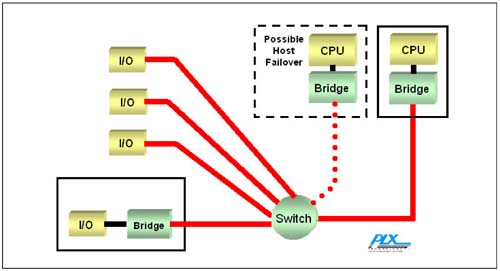
Storage SystemsPCI has become a common backplane technology for mainstream storage systems. Although it provides a good mix of features, low cost, and throughput, the "bus" has become a performance bottleneck. Figure B-5 on page 995 shows the use of PCI Express in a storage system. Systems similar to the one shown in Figure B-5 on page 995 can be built on a motherboard, or as part of a backplane. The discussion in this section applies to both form factors. Figure B-5. PCI Express in a Storage System
We have highlighted increased bandwidth as one of the advantages of moving to PCI Express, and nowhere is it more beneficial and obvious than in storage. The bandwidth demanded by I/O connections such as Ethernet, Fibre Channel, SCSI, and InfiniBand, is increasing rapidly. And the ability to move data between I/O modules and the host processor is critical to overall system performance. In RAID based storage systems, for example, data to be archived is distributed across several disk drives to provide faster data retrieval and fault tolerance. As performance and complexity increase in these systems, the need for faster read and write operations from multiple I/O locations (disk drives) becomes extremely important. PCI Express, with its high performance, point-to-point architecture becomes very desirable for this application. PCI Express provides a key reliability benefit in storage applications as well. The specification provides for two different types of error checking (CRC) schemes. There is CRC information between each link to ensure a reliable connection, and there is an optional end-to-end CRC that travels with the data from source to destination. In High Availability (HA) applications, a separate host can reside in the system (as shown in Figure B-5 on page 995) for failover. If and when the primary host becomes unstable or non-operational, the secondary host will take over control of the system. This is an important feature for system level reliability when the designer is attempting to eliminate as many single points of failure as possible. This secondary host will be integrated into the system using non-transparent bridging (a detailed discussion of non-transparent bridging is provided in Appendix C). |
| [ Team LiB ] |
|