| [ Team LiB ] |


|
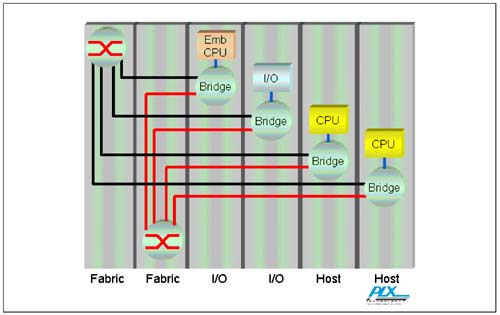
Communications SystemsThe last application that we will explore is the use of PCI Express in communications systems. As with previous usage models, PCI technology has in the past made significant inroads into communication systems, but over time it has become less desirable due to the inherent limitations of a shared bus. In general, serial interconnects such as PCI Express have become attractive to backplane system designers by providing switch-based topologies that enable higher reliability, scalability, and robustness. High end communications systems are based on one or more racks, with a midplane or backplane chassis used to interconnect each subsystem. Many systems use the CompactPCI architecture for their backplane implementations, and in some cases proprietary bus solutions are used to interconnect line cards, the switch fabric and the control modules. Some vendors are moving toward the AdvancedTCA™ (ATCA) architecture that supports a variety of different fabrics based upon a standard chassis for communication applications. ATCA has a range of benefits, but the PCI Express version of ATCA provides a smooth migration to higher speeds and a set of features that fit well with the communications paradigm. One feature common to many communications systems is the ability to assign priorities to different data streams based on Quality of Service (QoS). PCI Express offers Traffic Classes (TC) that can be used to differentiate types of data. These TCs are then mapped onto Virtual Channels (VC) within the hardware. Each VC has its own set of queues in the subsystem, providing a separate path through the switch or bridge. This mechanism can be used to provide separate channels for different types of traffic (I/O, data, special messages). Figure B-6 on page 997 shows a typical communication switch or router. Only 6 slots are shown for illustration purposes, but actual systems typically have 10+ slots. As shown in the figure, PCI Express technology can be used to support redundant switch fabrics and control modules, allowing communications equipment vendors to build high availability systems with a faster time to market. Figure B-6. PCI Express in Communications Systems
|
| [ Team LiB ] |
|