| [ Team LiB ] |


|
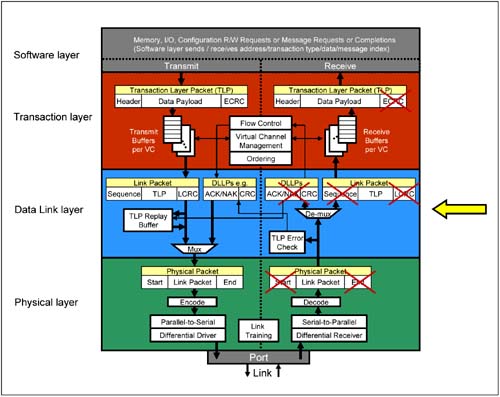
Reliable Transport of TLPs Across Each LinkThe function of the Data Link Layer (shown in Figure 5-1 on page 210) is two fold:
Figure 5-1. Data Link Layer
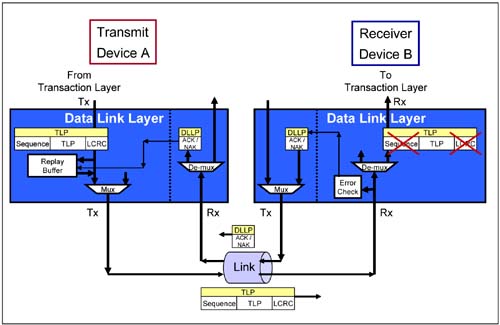
The ACK/NAK protocol associated with the Data Link Layer is described with the aid of Figure 5-2 on page 211 which shows sub-blocks with greater detail. For every TLP that is sent from one device (Device A) to another (Device B) across one Link, the receiver checks for errors in the TLP (using the TLP's LCRC field). The receiver Device B notifies transmitter Device A on good or bad reception of TLPs by returning an ACK or a NAK DLLP. Reception of an ACK DLLP by the transmitter indicates that the receiver has received one or more TLP(s) successfully. Reception of a NAK DLLP by the transmitter indicates that the receiver has received one or more TLP(s) in error. Device A which receives a NAK DLLP then re-sends associated TLP(s) which will hopefully, arrive at the receiver successfully without error. Figure 5-2. Overview of the ACK/NAK Protocol
The error checking capability in the receiver and the transmitter's ability to re-send TLPs if a TLP is not received correctly is the core of the ACK/NAK protocol described in this chapter. Definition: As used in this chapter, the term Transmitter refers to the device that sends TLPs. Definition: As used in this chapter, the term Receiver refers to the device that receives TLPs. |
| [ Team LiB ] |
|