| [ Team LiB ] |


|
Relaxed OrderingPCI Express supports the Relaxed Ordering mechanism introduced by PCI-X; however, PCI Express introduces some changes (discussed later in this chapter). The concept of Relaxed Ordering in the PCI Express environment allows switches in the path between the Requester and Completer to reorder some transactions just received before others that were previously enqueued. The ordering rules that exist to support the Producer/Consumer model may result in transactions being blocked, when in fact the blocked transactions are completely unrelated to any Producer/Consumer transaction sequence. Consequently, in certain circumstances, a transaction with its Relaxed Ordering (RO) attribute bit set can be re-ordered ahead of other transactions. The Relaxed Ordering bit may be set by the device if its device driver has enabled it to do so (by setting the Enable Relaxed Ordering bit in the Device Control register—see Table 24 - 3 on page 906). Relaxed ordering gives switches and the Root Complex permission to move this transaction ahead of others, whereas the action is normally prohibited. RO Effects on Memory Writes and MessagesPCI Express Switches and the Root Complex are affected by memory write and message transactions that have their RO bit set. Memory write and Message transactions are treated the same in most respects—both are handled as posted operations, both are received into the same Posted buffer, and both are subject to the same ordering requirements. When the RO bit is set, switches handle these transactions as follows:
RO Effects on Memory Read TransactionsAll read transactions in PCI Express are handled as split transactions. When a device issues a memory read request with the RO bit set, the request may traverse one or more switches on its journey to the Completer. The Completer returns the requested read data in a series of one or more split completion transactions, and uses the same RO setting as in the request. Switch behavior for the example stated above is as follows:
Table 8-1 summarizes the relaxed ordering behavior allowed by switches.
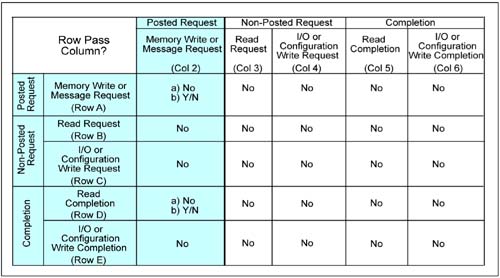
Summary of Strong Ordering RulesThe PCI Express specification defines strong ordering rules associated with transactions that are assigned the same TC value, and further defines a Relaxed Ordering attribute that can be used when a device knows that a transaction has no ordering relationship to other transactions with the same TC value. Table 8-2 on page 322 summarizes the PCI Express ordering rules that satisfy the Producer/Consumer model and also provides for Relaxed Ordering. The table represents a draconian approach to ordering and does not consider issues of performance, preventing deadlocks, etc. The table applies to transactions with the same TC assignment that are moving in the same direction. These rules ensure that transactions will complete in the intended program order and eliminates the possibility of deadlocks in a pure PCI Express implementation (i.e., systems with no PCI Bridges). Columns 2 - 6 represent transactions that have previously latched by a PCI Express device, while column 1 represents subsequently-latched transactions. The ordering relationship between the transaction in column 1 to other transactions previously enqueued is expressed in the table on a row-by-row basis. Note that these rules apply uniformly to all transaction types (Memory, Messages, IO, and Configuration). The table entries are defined as follows: No — The transaction in column 1 must not be permitted to proceed ahead of the previously enqueued transaction in the corresponding columns (2-6). Y/N (Yes/No) — The transaction in column 1 is allowed to proceed ahead of the previously enqueued transaction because its Relaxed Ordering bit is set (1), but it is not required to do so. Table 8-2. Fundamental Ordering Rules Based on Strong Ordering and RO Attribute
Note that the shaded area represents the ordering requirements that ensure the Producer/Consumer model functions correctly and is consistent with the basic rules associated with strong ordering. The transaction ordering associated with columns 3 - 6 play no role in the Producer/Consumer model.  |
| [ Team LiB ] |
|