| [ Team LiB ] |


|
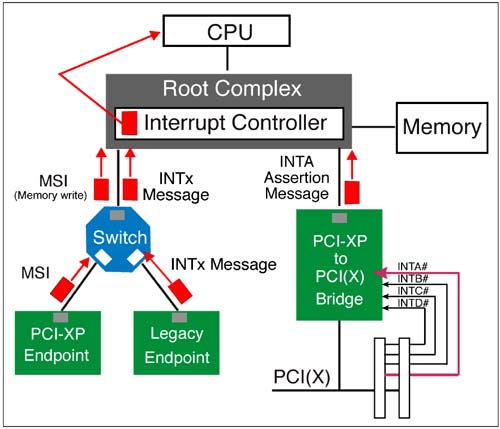
Two Methods of Interrupt DeliveryInterrupt delivery is conditionally optional for PCI Express devices. When a native PCI Express function does depend upon delivering interrupts to call its device driver, Message Signaled Interrupts (MSI) must be used. However, in the event that a device connecting to a PCI Express link cannot use MSIs (i.e., legacy devices), an alternate mechanism is defined. Both mechanisms are summarized below: Native PCI Express Interrupt Delivery — PCI Express eliminates the need for sideband signals by using the Message Signaled Interrupt (MSI), first defined by the 2.2 version of the PCI Specification (as an optional mechanism) and later required by PCI-X devices. The term "Message Signaled Interrupt" can be misleading in the context of PCI Express because of possible confusion with PCI Express's "Message" transactions. A Message Signaled Interrupt is not a PCI Express Message, instead it is simply a Memory Write transaction. A memory write associated with an MSI can only be distinguished from other memory writes by the address locations they target, which are reserved by the system for Interrupt delivery. Legacy PCI Interrupt Delivery — This mechanism supports devices that must use PCI-Compatible interrupt signaling (i.e., INTA#, INTB#, INTC#, and INTD#) defined for the PCI bus. Legacy functions use one of the interrupt lines to signal an interrupt. An INTx# signal is asserted to request interrupt service and deasserted when the interrupt service accesses a device-specific register, thereby indicating the interrupt is being serviced. PCI Express defines in-band messages that act as virtual INTx# wires, which target the interrupt controller located typically within the Root Complex. Figure 9-1 illustrates the delivery of interrupts from three types of devices:
Figure 9-1. Native PCI Express and Legacy PCI Interrupt Delivery
 |
| [ Team LiB ] |
|