| [ Team LiB ] |


|
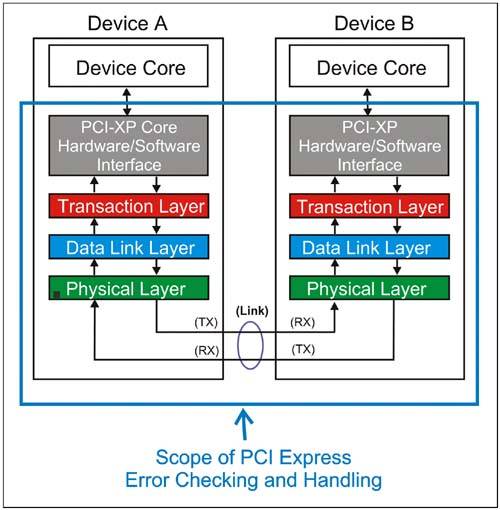
Introduction to PCI Express Error ManagementPCI Express defines a variety of mechanisms used for checking errors, reporting those errors and identifying the appropriate hardware and software elements for handling these errors. PCI Express Error Checking MechanismsPCI Express error checking focuses on errors associated with the PCI Express interface and the delivery of transactions between the requester and completer functions. Figure 10-1 on page 357 illustrates the scope of the error checking that is the focus of this chapter. Errors within a function that do not pertain to a given transaction are not reported through the error handling procedures defined by the PCI Express specification, and it is recommended that such errors be handled using proprietary methods that are reported via device-specific interrupts. Each layer of the PCI Express interface includes error checking capability as described in the following sections. Figure 10-1. The Scope of PCI Express Error Checking and Reporting
Transaction Layer ErrorsThe transaction layer checks are performed only by the Requestor and Completer. Packets traversing switches do not perform any transaction layer checks. Checks performed at the transaction layer include:
Data Link Layer ErrorsLink layer error checks occur within a device involved in delivering the transaction between the requester and completer functions. This includes the requesting device, intermediate switches, and the completing device. Checks performed at the link layer include:
Physical Layer ErrorsPhysical layer error checks are also performed by all devices involved in delivering the transaction, including the requesting device, intermediate switches, and the completing device. Checks performed at the physical layer include:
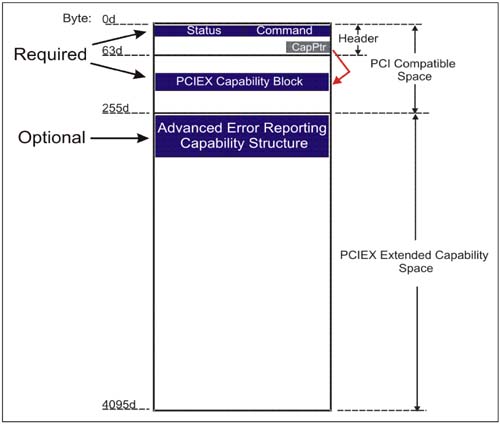
Error Reporting MechanismsPCI Express provides three mechanisms for establishing the error reporting policy. These mechanisms are controlled and reported through configuration registers mapped into three distinct regions of configuration space. (See Figure 10-2 on page 360.) The various error reporting features are enabled as follows:
Figure 10-2. Location of PCI Express Error-Related Configuration Registers
The specification refers to baseline (required) error reporting capabilities and advanced (optional) error reporting capabilities. The baseline error reporting mechanisms require access to the PCI-compatible registers and PCI Express Capability registers (bullets 1 and 2 above), while advanced error reporting (bullet 3) requires access to the Advanced Error Reporting registers that are mapped into extended configuration address space as illustrated in Figure 10-2. This chapter details all error reporting mechanisms. Error Handling MechanismsErrors are categorized into three classes that specify the severity of an error as listed below. Note also the specification defines the entity that should handle the error based on its severity:
By defining errors into these classes, error handling software can be partitioned into separate handlers to perform the actions required for a given platform. The actions taken based on severity of an error might range from monitoring the effects of correctable errors on system performance to simply resetting the system or PCI Express sub-system in the event of a fatal error. Note that regardless of the severity of a given error, software can establish a policy whereby any error can be reported to the system (via the Root Complex) for the purpose of tracking and logging. (See page 390 for details.) |
| [ Team LiB ] |
|