| [ Team LiB ] |


|
Sources of PCI Express ErrorsThis section provides a more detailed description of the error checks made by PCI Express interfaces when handling transactions. ECRC Generation and CheckingECRC generation and checking is optional and only supported by devices and systems that implement Advanced Error Reporting. Devices that support ECRC must implement the Advanced Error Capabilities and Control Register. Configuration software checks this register to determine if ECRC is supported, and to enable ECRC support. A PCI Express device that originates a transaction (Request or Completion) can create and append a 32-bit CRC (within the digest field) that covers the header and data portions of the transaction. This CRC is termed end-to-end (ECRC) and is typically checked and reported by the ultimate recipient of the transaction. Switches in the path between the originating and receiving devices may optionally check and report ECRC errors, or merely forward the packet without checking the ECRC. If a Switch detects an ECRC error it must still forward the packet unaltered as it would any other packet. Switches may also be the originator or recipient of a transaction in which case they can participate in ECRC generation and checking in this role. The actions taken when an ECRC error is detected is considered beyond the scope of the specification. However, the possible actions taken will likely depend on whether the ECRC error occurs in a Request or Completion:
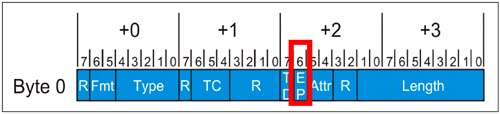
Note that ECRC errors may also result in error messages being sent to the host for handling or logging. Data Poisoning (Optional)Data poisoning provides a way of indicating that data associated with a transaction is corrupted. When a TLP is received that contains a data field, the recipient will know that data is corrupted if the poisoned bit is set. Figure 10-3 illustrates the Error/Poisoned bit (EP) located within the first Dword of a packet. Figure 10-3. The Error/Poisoned Bit within Packet Headers
The specification includes three examples of data corruption that could result in data poisoning being used. In each of these cases, the error can be forwarded to the recipient via the data poisoning bit in the transaction header.
The specification states that data poisoning applies to data associated with both posted and non-posted writes and read completions. Therefore data poisoning can be used in conjunction with Memory, I/O, and Configuration transactions that have a data payload. Data poisoning can only be done at the transaction layer of a device. The link layer does not process or in any way affect the contents of the TLP header. The transaction layer indicates that data is corrupted by setting the Data Error/Poisoned bit (E/P) in the Write request or Read Completion transaction header. Data poisoning errors are enabled and reported via the Uncorrectable Error Registers. TC to VC Mapping ErrorsAll PCI Express ports that implement the extended VC capability (endpoints, switches, and root ports) must check to verify that the TC of each inbound packet is mapped to an active VC. Packets with TC's that fail this check are treated as malformed TLPs. Similarly, when switches forward packets, they must also verify that the target outbound port of the switch also supports the packet's TC. If not, the packet is treated as a malformed TLP. A requester or completer may implement more than one Virtual Channel (VC) and enable more than one Traffic Class (TC). If the device core issues a request to send a transaction with a TC number that is not enabled (pointing to an active VC) within the TC to VC mapping tables, the transaction is rejected and a malformed TLP is indicated. If the device has implemented the PCI Express Virtual Channel Capability structure (supports multiple VCs and/or TC filtering), then the malformed TLP error is detected at the transmitting device. However, if the device only supports the default TC0/VC0 configuration, then this error would be detected at the first receiving device along the packet's path that implements the extended VC capability and applies TC filtering. Note also that the TC to VC mapping is a transaction layer function. (See "Assigning TCs to each VC — TC/VC Mapping" on page 262 for details). Link Flow Control-Related ErrorsPrior to forwarding the packet to the link layer for transmission across the link, the transaction layer must check flow control credits to ensure that the receive buffers in the adjacent node (switch or completer) have sufficient room to hold the transaction. Flow control protocol errors may occur that will likely prevent transactions from being sent. These errors can be reported to the Root Complex and are considered uncorrectable. The uncorrectable error registers are used to enable and check status for Flow Control (FC) errors. The specification does not require that these errors be checked and reported. All five conditions that cause flow control related errors (flow control protocol errors and receiver overflow errors) are detected by and associated with the port receiving the flow control information. These error conditions are:
Flow Control Protocol errors are reported as uncorrectable errors, if supported and enabled. Malformed Transaction Layer Packet (TLP)When the ultimate recipient of a transaction receives a request or completion packet into the transaction layer, the packet format is checked for violations of the TLP formatting rules. The specification defines the following items that cause a malformed packet:
Split Transaction ErrorsA variety of failures can occur during a split transaction. When a transaction request is sent to a destination device a completion transaction is expected in response (except for Memory Write and Message transactions which are posted transactions). The various failure modes that can occur are discussed in the following sections. Unsupported RequestWhen a recipient of a transaction request detects that it does not support this transaction, it returns a completion transaction with unsupported request (UR) specified in the completion status field. The specification defines a number of specific conditions that cause UR to be returned in the completion status field:
Completer AbortThese type of error checks are optional. Three circumstances can occur that could result in a Completer returning an abort to the Requester:
A Completer that aborts a request may report the error to the Root Complex as a Non-Fatal Error message. Further, if the aborted request requires a completion, the completion status would be reported as CA. Unexpected CompletionA completion transaction that arrives at a Requester uses the transaction descriptor (Requester ID and Tag) to match the request to which this completion applies. In rare circumstances the transaction descriptor may not match a request that is pending completion. The typical reason for this unexpected completion is that the completion was mis-routed on its journey back to the intended requester. Consequently, two requesters will be surprised:
A Non-Fatal Error message can be sent by the device that receives the unexpected completion. Completion Time-outThe previous discussion points out that a completion transaction can be routed to the wrong device. Consequently, the pending request will never receive its completion. The specification defines the completion time-out mechanism to identify this situation and report the error to requester software for possible recovery. The specification clearly defines that the intent of the completion time-out is to detect when a completion has no reasonable chance of returning and not related to expected latencies associated with split transactions. The completion time-out mechanism must be implemented by any device that initiates requests that require completions to be returned. An exception is allowed for devices that only initiate configuration transactions. The specification defines the permissible range of the time-out value as follows:
Note that for Memory Read requests a request may require two or more completions to return all of the requested data. All of the data must be returned prior to the time-out. If some but not all of the data has been returned when the time-out occurs, the requester may either discarded or keep the data. |
| [ Team LiB ] |
|