| [ Team LiB ] |


|
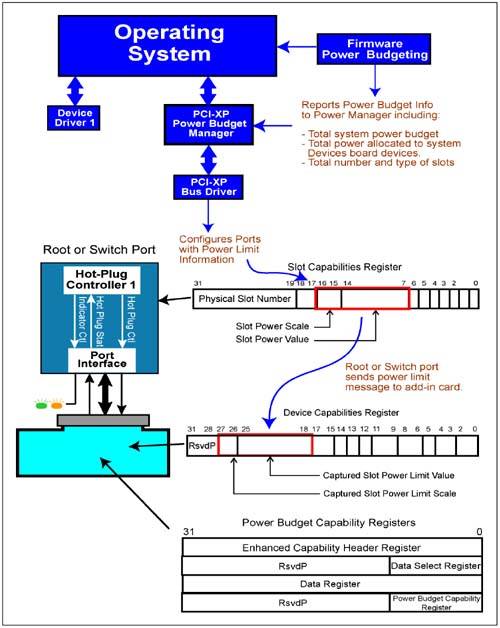
The Power Budgeting ElementsFigure 15-2 illustrates the concept of Power Budgeting for hot plug cards. The role of each element involved in the power budgeting, allocation, and reporting process is listed and described below:
Figure 15-2. Elements Involved in Power Budget
System Firmware — System firmware, having knowledge of the system design, is responsible for reporting system power information. The specification recommends the following power information be reported to the PCI Express power budget manager, which allocates and verifies power consumption and dissipation during runtime:
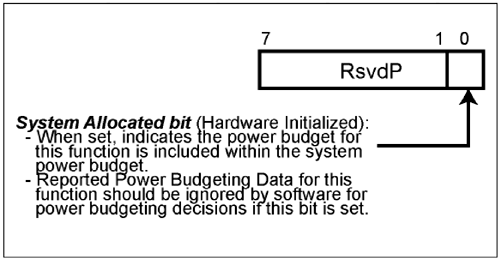
Firmware may also allocate power to PCI Express devices that support the power budgeting capability configuration register set (e.g., a hot-plug device used during boot time). The Power Budgeting Capability register (see Figure 15-1) contains a System Allocated bit that is intended to be set by firmware to notify the power budget manager that power for this device has been included in the system power allocation. Note that the power manager must read and save power information for hot-plug devices that are allocated by the system, in case they are removed during runtime. Figure 15-1. System Allocated Bit
The Power Manager — The power manager initializes when the OS installs, at which time it receives power-budget information from system firmware. The specification does not define the method for communicating this information. The power budget manager is responsible for allocating power for all PCI Express devices. This allocation includes:
Expansion Ports — Figure 15-2 on page 561 illustrates a hot plug port that must have the Slot Power Limit and Slot Power Scale fields within the Slot Capabilities register implemented. The firmware or power budget manager must load these fields with a value that represents the maximum amount of power supported by this port. When software writes to these fields the port delivers the Set_Slot_Power_Limit message to the device. These fields are also written when software configures a card that has been added during a hot plug installation. The PCI Express specification requires that:
Add-in Devices— Expansion cards that support the power budgeting capability must include the:
These devices must not consume more power than the lowest power specified by the form factor specification. Once power budgeting software allocates additional power via the Set_Slot_Power_Limit message, the device can consume the power specified, but not until it has been configured and enabled. Device Driver— The device's software driver is responsible for verifying that sufficient power is available for proper device operation prior to enabling it. If the power is lower than that required by the device, the device driver is responsible for reporting this to a higher software authority. |
| [ Team LiB ] |
|