| [ Team LiB ] |


|
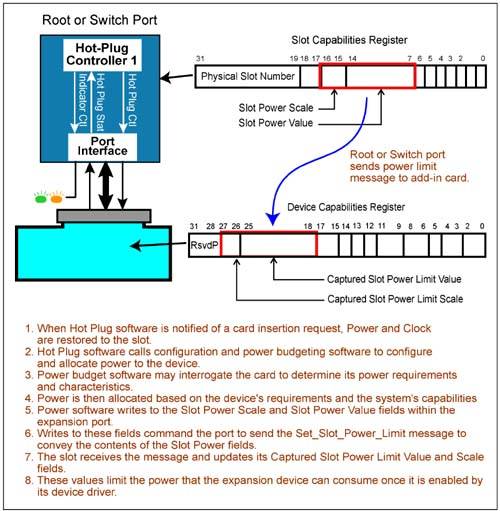
Slot Power Limit ControlSoftware is responsible for determining the maximum amount of power that an expansion device is allowed to consume. This power allocation is based on the power partitioning within the system, thermal capabilities, etc. Knowledge of the system's power and thermal limits comes from system firmware. The firmware or power manager (which receives power information from firmware) is responsible for reporting the power limits to each expansion port. Expansion Port Delivers Slot Power LimitSoftware writes to the Slot Power Limit Value and Slot Power Limit Scale fields of the Slot Capability register to specify the maximum power that can be consumed by the device. Software is required to specify a power value that reflects one of the maximum values defined by the specification. For example, the electromechanical specification defines maximum power listed in Table 15-1.
When these registers are written by power budget software, the expansion port sends a Set_Slot_Power_Limit message to the expansion device. This procedure is illustrated in Figure 15-3 on page 563. Figure 15-3. Slot Power Limit Sequence
Expansion Device Limits Power ConsumptionThe device driver reads the values from the Slot Power Limit and Scale fields to verify that the power available is sufficient to operate the device. Several conditions may exist:
Some devices implemented on expansion devices may consume less power than the lowest limit specified for the form factor. Such devices are permitted to discard the information delivered in the Set_Slot_Power_Limit Messages. When the Slot Power Limit Value and Scale fields are read, these devices return zeros.  | ||||||||||||||||||
 the power required to operate the device at full capability. In this case, the driver enables the device by writing to the configuration Command register, permitting the device to consume up to the amount of power specified in the Power Limit fields.
| [ Team LiB ] |
|