| [ Team LiB ] |


|
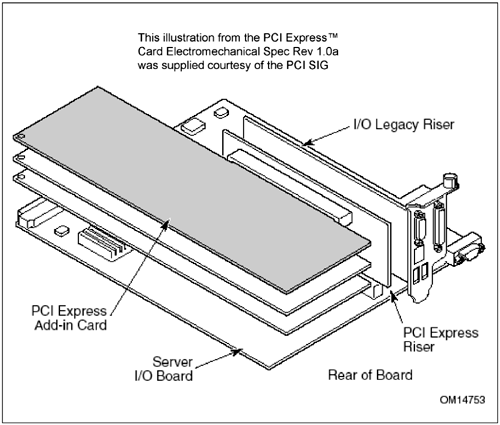
Form Factors Under DevelopmentGeneralIn addition to the cards and slots that are defined with the PCI Express Card Electromechanical spec, there are other form factors currently under development by various groups. These form factors are usually designed for a particular class of applications and thus have different constraints. A card designed for a server application for example, will typically have a bigger power budget and more space available than one designed for a mobile application. The specs for these form factors were still under development at the time of this publication and are therefore subject to change. Server IO Module (SIOM)The PCI SIG is currently developing a module for the server environment called the Server IO Module (SIOM). It has four form factors: a base version and a full version, both of which can use a single- or double-width card. The built in hot swap capability of PCI Express helps make this module attractive to the server market because it allows changes to be readily made to the system on the fly. Riser CardFigure 18-7 on page 704 illustrates an example of a PCI Express riser card. Figure 18-7. PCI Express Riser Card
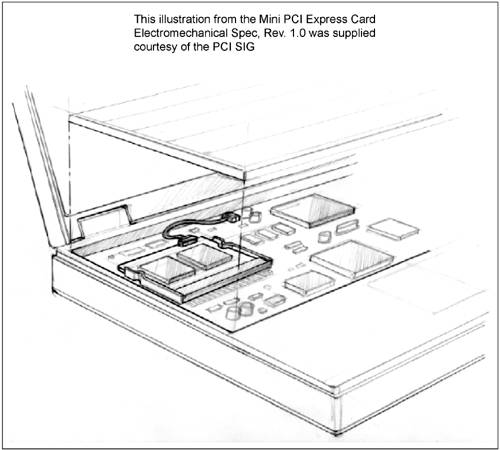
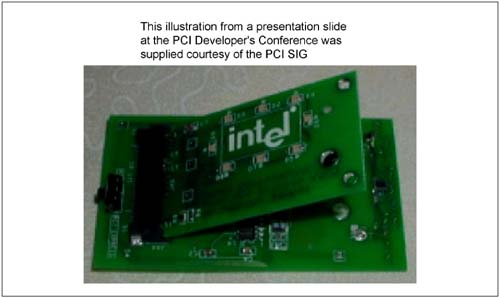
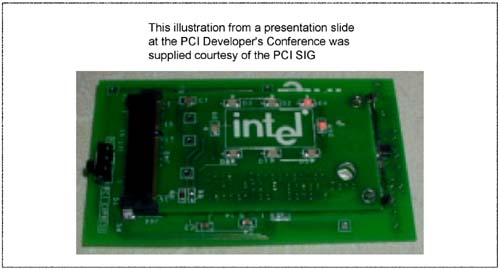
Mini PCI Express CardRefer to Figure 18-8 on page 705, Figure 18-9 on page 706 and Figure 18-10 on page 706. The Mini PCI Express add-in card is similar to the conventional Mini PCI card, but is about half the size, uses smaller connectors and is optimized for mobile computing platforms and communications applications. It is designed with an interface that includes a x1 PCI Express connector, a USB 2.0 connector, and several LED indicators. While this form factor is designed for adding functionality internal to the system and therefore does not allow the user to readily make changes to the system, it does facilitate build-to-order or configure-to-order manufacture by making it easy to customize the functionality of a machine simply by choosing which cards to add or leave out of a product during assembly. This spec is being developed by the PCI SIG. Figure 18-8. Mini PCI Express Add-in Card Installed in a Mobile Platform
Figure 18-9. Mini PCI Express Add-in Card Photo 1
Figure 18-10. Mini PCI Express Add-in Card Photo 2
NEWCARD form factorNEWCARD is a standard that is similar to the Mini PCI Express in functionality but is designed for the user to readily install or remove. This spec is being developed by the PCMCIA group (Personal Computer Memory Card International Association) for use in desktop and mobile devices, and is expected to ultimately replace the existing CardBus PC card solution for these computers. Like the Mini PCI Express standard, the NEWCARD interface is defined to contain a x1 PCI Express connector, a USB 2.0 connector, and several LED indicators. For desktop machines, NEWCARD will offer the hot plug and hot swap capabilities of PCI Express and USB, and allow a user to upgrade or expand the machine without having to open it. Since the card will be able to fit into mobile computers, it will also be possible for the user to share a NEWCARD device between desktop and mobile computers. For a communications-specific card, the IO interface side of the card might include wired connections such as a modem or Ethernet interface, or a wireless port such as a cellular or Bluetooth connection.  |
| [ Team LiB ] |
|