| [ Team LiB ] |


|
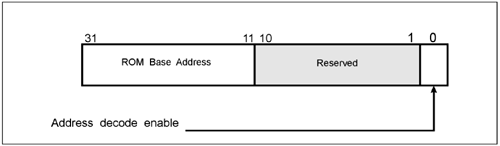
ROM DetectionWhen the configuration software is configuring a PCI, PCI-X, or PCI-Express function, it determines if a function-specific ROM exists by checking to see if the designer has implemented an Expansion ROM Base Address Register (refer to Figure 23-1 on page 873). Figure 23-1. Expansion ROM Base Address Register Bit Assignment
As described in "Expansion ROM Base Address Register" on page 783, the programmer writes all ones (with the exception of bit zero, to prevent the enabling of the ROM address decoder; see Figure 23-1 on page 873) to the Expansion ROM Base Address Register and then reads it back. If a value of zero is returned, then the register is not implemented and there isn't an expansion ROM associated with the device. On the other hand, the ability to set any bits to ones indicates the presence of the Expansion ROM Base Address Register. This may or may not indicate the presence of a device ROM. Although the address decoder and a socket may exist for a device ROM, the socket may not be occupied at present. The programmer determines the presence of the device ROM by:
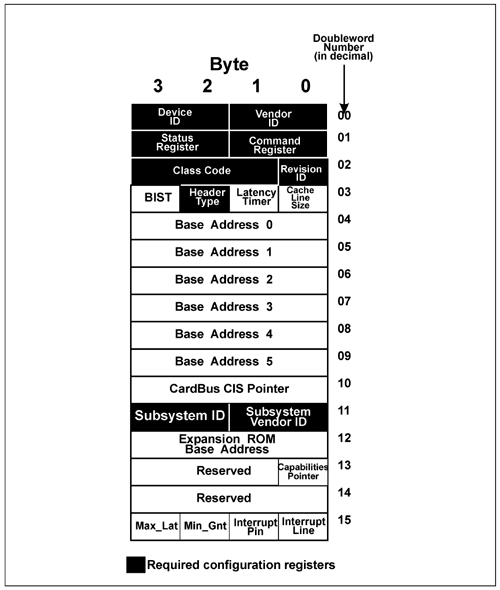
If the first two locations contain the ROM signature—AA55h—then the ROM is present. Figure 23-1 on page 873 illustrates the format of the Expansion ROM Base Address Register. Assume that the register returns a value of FFFE0000h when read back after writing all ones to it. Bit 17 is the least-significant bit that was successfully changed to a one and has a binary-weighted value of 128K. This indicates that it is a 128KB ROM decoder and bits [24:17] within the Base Address field are writable. The programmer now writes a 32-bit start address into the register and sets bit zero to one to enable its ROM address decoder. The function's ROM address decoder is then enabled and the ROM (if present) can be accessed. The maximum ROM decoder size permitted by the PCI spec is 16MB, dictating that bits [31:25] must be read/write. The programmer then performs a read from the first two locations of the ROM and checks for a return value of AA55h. If this pattern is not received, the ROM is not present. The programmer disables the ROM address decoder (by clearing bit zero of the Expansion ROM Base Address Register to zero). If AA55h is received, the ROM exists and a device driver code image must be copied into main memory and its initialization code must be executed. This topic is covered in the sections that follow. Figure 23-2. Header Type Zero Configuration Register Format
 |
| [ Team LiB ] |
|